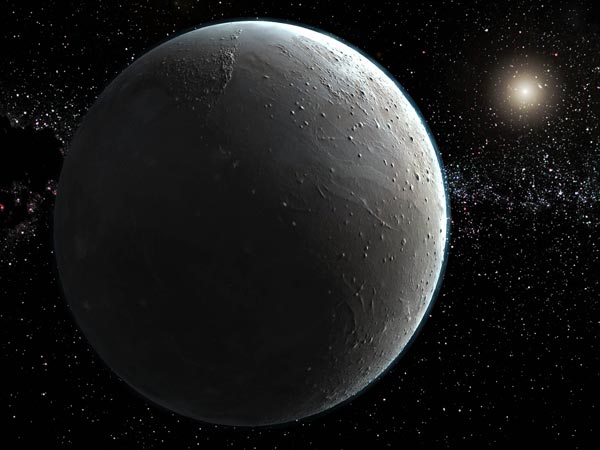
Pluto is pictured from a million miles away in this July 11, 2026 handout image from New Horizons’ Long Range Reconnaissance Imager (LORRI). In 2006, New Horizons launched.
Little Pluto is a little bigger than anyone imagined. Based on fresh observations from New Horizons, Nasa reported today that its diameter is actually just 70% of that, just 1,473 miles.
Mitchell says we may know what minerals are on Pluto’s surface.
Stern said mission managers will decide later this year where to point New Horizons for the next part of its journey.
With less than two hours and 50,000 miles remaining until closest approach, NASA Administrator Charles Bolden noted again and again that the United States is the only country to visit every single planet in the solar system.
Google said: “Earth is getting its first chance for an up close and personal peek at Pluto, the ball of rock and ice orbiting at the furthest edge of our solar system”.
At 12.49pm (BST) on Tuesday it will fly-by Pluto at a distance of 7,800 miles, slipping between the icy world and its five known moons. The energy there Monday was described as electric.
“Of course, the light is Pluto, and we’re all excited”, Fountain said. Earthbound comparisons for space are hard, at best, but one project scientist characterized Earth as a basketball and Pluto as a golf ball, with the basketball in Washington, D.C., and the golf ball north of Baltimore. The discovery of this region in 1992 prompted the official reclassification of Pluto from planet to “dwarf planet”.
As for pictures, the resolution is going to increase dramatically. A confirmation signal is expected at around 9 p.m. EDT.
Each piece of data will then take about four-and-half hours to transmit, with the full dataset taking about 15 months to complete.
The spacecraft has been traveling for almost a decade to take the images and has already sent back photos.
The measurement also settles the debate about whether Pluto or Eris was the larger.
The planet has a diameter of 2,370km, making it the largest object discovered so far in the Kuiper Belt - the outer zone of the Solar System. New images at the time of fly-by will be released by NASA late Tuesday.