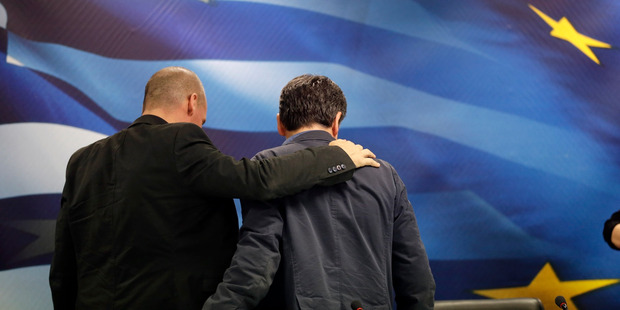
The referendum result - a rejection of more austerity after five years of pain for Greece, came as a surprise to many European governments - because “lots of people were relying on the rationality of the process, and confused their desires for reality”, he added.
This would make Germany Greece’s largest creditor in the eurozone and the country with the most to lose from a Greek default.
Steinmeier told Berlin’s Tagesspiegel am Sonntag newspaper that the debt situation in Greece, the unsolved problem of how to handle tens of thousands of migrants flooding in across the Mediterranean and Britain’s demands for European Union reforms are straining the EU’s foundations. “People in creditor countries now expect their representatives to protect their interest and the European interest too”.
Merkel, who has worked hard behind the scenes to avoid a Greek exit, saying last week that “where there’s a will, there’s a way”, finds herself boxed in following the referendum by the increasingly hard line of her conservative allies and coalition partners, the centre-left Social Democrats (SPD). Unemployment in Greece for young people under 25 stands at a whopping 51.9 percent. “I need to know that there is light at the end of tunnel, that the lives of my children will be better”, she said. She said that listening to the 18 other eurozone states “is also democracy”.
With fears a “No” vote could lead to Greece exiting the eurozone - a so-called “Grexit” - Pawel Tokarski of the German Institute for worldwide and Security Affairs said its impact would reach much further.
Tsipras has also spoken by telephone to French President Francois Hollande, who is trying to broker an agreement ahead of Tuesday’s Brussels summit.
“We want to continue the discussion”, said Tsakalotos, who admitted to having “stage fright” upon assuming the post “not at the easiest moment in Greek history”.
Polls published Friday showed the two sides in a dead heat over whether to accept creditors’ demands for more austerity or reject them.
In Frankfurt, the European Central Bank said its governing council had decided to maintain emergency funding to Greek banks - so-called emergency Liquidity Assistance (ELA) - at the level set on June 26, keeping it at roughly 89 billion euros. “The first document is titled “reforms for the completion of the current program and beyond” and the second ‘Preliminary debt sustainability analysis.'”.
Tsipras “destroyed the last bridges of compromise between Europe and Greece”, he said in the wake of Sunday’s vote.
Finance Ministry spokesman Martin Jaeger said Germany’s “position is well-known… a debt cut is not an issue for us”.
Tsipras said the referendum “defeats fear and ultimatums”.
“We want Tsipras and this government in power”.
A Greek government official said Monday that Russian President Vladimir Putin had asked to speak with the Greek premier.
“I stress the fact that time is running out and there is urgency - urgency for Greece and urgency for Europe”, he said after meeting Merkel in Paris a day after Greek voters rejected bailout proposals by global lenders. Instead, they argue by voting “yes” Greece would get a new deal quickly to shore up its sinking economy. He had campaigned for Sunday’s “No” vote, accusing Greece’ creditors of “terrorism”. “We vote “yes” to Europe”. His daughter Alexandra is voting “no” because she is tired of richer European nations bossing Greece around. Still, they are united in their belief that only as a strong family can they weather the coming storm.
Should Greece default on the bonds held by the European and national central banks, Germany would face a hit of up to EUR7.1 billion. “Solidarity is everywhere to be seen in Europe and must be seen even more”.
Tsipras, meanwhile, called Merkel and other European leaders, assuring them that he was prepared to make new proposals that would clear the path for talks on new aid.
Pouring more money into the black hole of Greece’s finances will not be popular with voters in other eurozone countries, particularly in the more hardline Baltics, Finland and the Netherlands, said Anne Laure Delatte, an economist at the French Institute for Scientific Research.