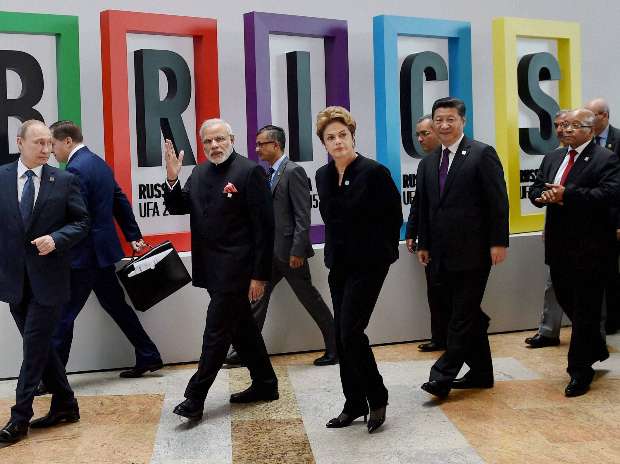
“This is among the four reasons, based on which I should say the seventh BRICS summit is a complete success”, said Zhang Jun, Director General of Department of global Economic Cooperation of the Ministry of Foreign Affairs, to reporters in Ufa.
Russia, hit by sanctions by the United States, Japan and European countries, is boosting its relations with non-Western countries, in rivalry with the Group of Seven industrial countries, sources said. Foreign secretary S Jaishankar said in a briefing after the 90-minute interaction between the two leaders that energy sector cooperation was a key area for rebooting the engagement, including nuclear engagement and hydrocarbons.
The regular membership of India and Pakistan, who are observers of the SCO, has been approved and they will be inducted formally next year.
Established in 1996, the SCO is a political, economic and military organization that incorporates China, Russia, Kazakhstan, Kyrgyzstan Tajikistan and Uzbekistan. “We want a multi-dimensional relationship with Russian Federation in the fields of trade, defence, energy, infrastructure, culture, and other spheres”, the PM said.
Welcoming SCO’s planned enlargement, Xi called on the member states to uphold the “Shanghai Spirit” for common development, China’s state-run Xinhua news agency reported.
“We share the same position with regard to the challenges in front of us, and one of the most important issues on that list is the fight against terrorism”.
At the meeting, SCO leaders laid the groundwork for the inclusion of Pakistan and India into the organization with full membership status.
Ufa (Russia): Prime Minister Narendra Modi on Thursday proposed a BRICS sports council with football meets, and suggested that the first football event could be held in India, which is to host the next summit. A separate meeting between Sharif and Modi led to plans for Modi to visit Pakistan next year.
Still, Putin stressed that Russian Federation is willing to cooperate in all kinds of mechanisms with any country that is interested in such cooperation, including the US and European countries. But while China and Russian Federation also used the SCO to maintain a dialogue, contemplating their respective strategic interests in Central Asia and the grouping’s potential value, they had different visions, which stalled the SCO’s development.