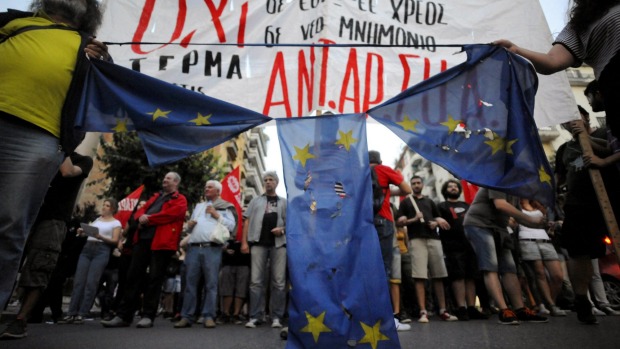
His argument, however, was dismissed by the head of the eurozone finance ministers’ group, Dutch Finance Minister Jeroen Dijsselbloem. “So that cannot happen and will not happen”.
In Athens, crowds of anxious elderly Greeks thronged banks for hours from before dawn Wednesday, struggling to be allowed to withdraw their maximum of 120 euros ($134) for the week after the government reopened some banks to help pensioners who don’t have bank cards.
The move increased fears the country could soon fall out of the euro currency bloc and Greeks rushed to pull money out of ATMs, leading the government to shutter its banks Monday and impose restrictions on banking transactions for at least a week. Even with a withdrawal limit of only 60 euros a day, there were signs of banknote shortages, with bankers saying 50-euro and 20-euro notes were running low.
Four members of the right-wing Independent Greeks, uneasy bedfellows whose 13 votes Tsipras’ left-wing Syriza party needs for a majority, defied him in the space of 24 hours by urging Greeks to accept more austerity in return for cash.
After the 19 ministers held a teleconference Wednesday, Pater Kazimir of Slovakia wrote on his official Twitter account: “Eurogroup united in decision to wait for the outcome of the Greece referendum before any further talks”. He said the question being put to the people was “not very clear” and his agency, which monitors votes, had not been invited to do so. Though it has significant credibility, it has no enforcement powers of its own.
Fitch said it now considered a default on privately-held debt “probable”.
But those hopes were quickly dashed.
Earlier, European Commission vice-president, Valdis Dombrovskis, the vice-president with responsibility for the euro said that the referendum question on which Greek voters are being asked to vote “is neither factually nor legally correct”.
Mr Varoufakis admitted the IMF’s assessment was “music to his ears” as he and his government had been arguing all along that Greece’s debt was unsustainable. It did not provide details.
Dragasakis, the Greek deputy prime minister, said the country’s new proposal “narrows the differences further”. “We have to do something, for the future of our children and our grandchildren”, she said. “There are six points where this effort can be made”. They want Greece to stay in the eurozone. “But it includes pensions and labor issues”.
The government says this is scaremongering, and that a rejection of creditor demands will mean the country is in a better negotiating position. Mr Tsipras is to speak at the No rally in the capital’s main Syntagma Square outside Parliament, while Yes supporters will gather at the nearby Panathenian Stadium, where the first modern Olympics were held in 1896. “Europe!”
French Finance Minister Michel Sapin, who has been most sympathetic to Athens in the negotiations, said in a television interview: “It is a vote with consequences”. Is it because they want to get rid of us?
“We don’t know how this government has performed”. “The creditors need to water down their positions too”.
The report explains that in 2012, eurozone governments agreed to “transfer an amount equal to any profit on SMP holdings of the country’s debt as long as it complies with the conditions of its surveillance programme”. “The European stability facility is not there for Greece anymore”. Tsipras sent a letter to creditors saying his government was prepared to accept their proposals, subject to certain amendments.
Tspiras has staked his job on the referendum.
An opinion poll showed opposition to the bailout in the lead but also that the gap had narrowed significantly as the bank closure and capital controls began to bite. Its up to the Greeks to respond..
Tsipras said Europe must stop acting in an “undemocratic way” and sought to reassure Greeks that their bank deposits were safe. The same day, the country also became the first developed nation to miss a debt repayment to the global Monetary Fund. And with its bailout program expiring, Greece will lose access to more than 16 billion euros ($18 billion) in financial support it has not yet tapped.