 iFreePress Bringing News on Time Every Time
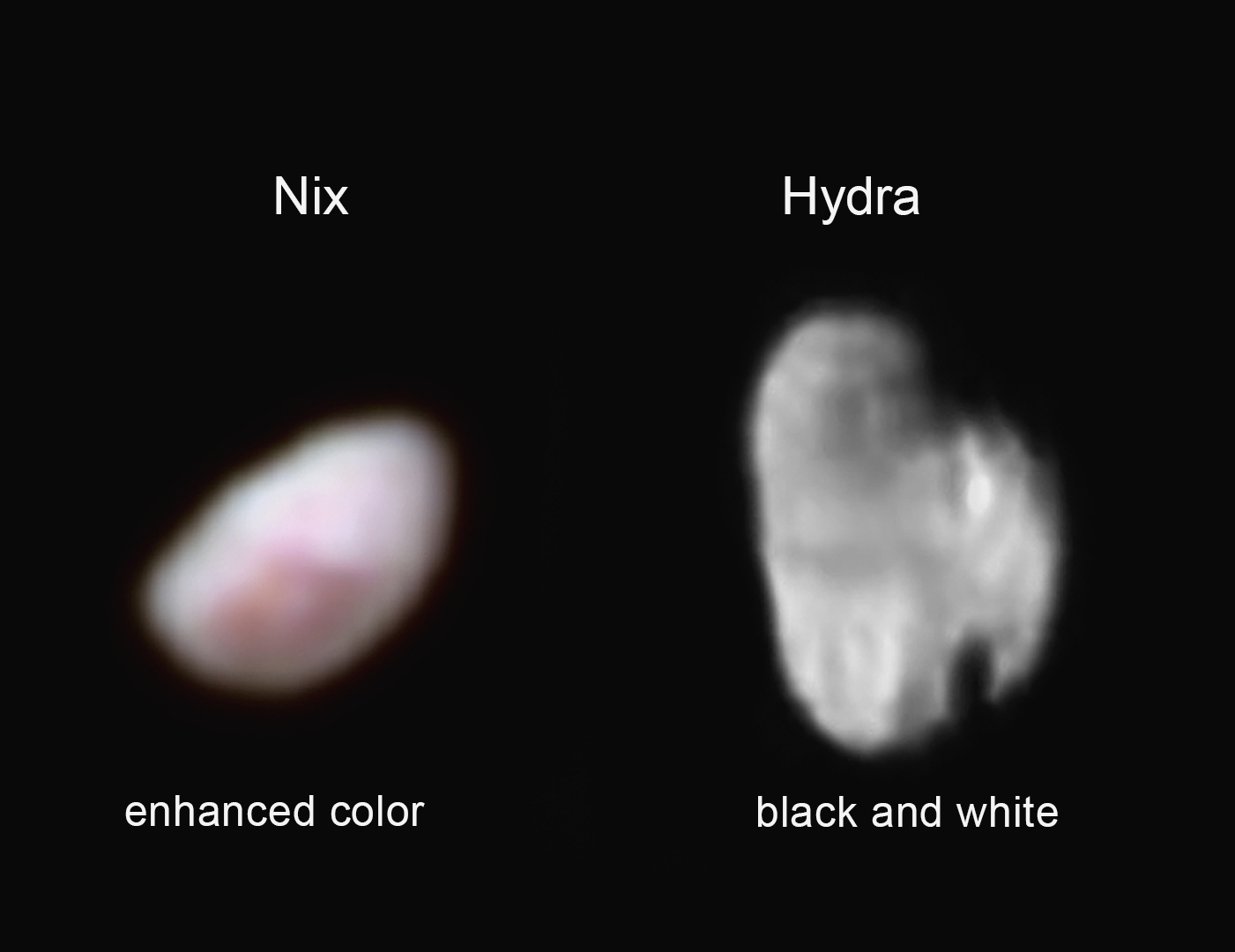
 New views of Nix and Hydra, two of Pluto’s four smallest moons, show the tiny worlds in detail for the first time. Once mere specks of light to telescopes and more recently a handful of gray pixels, Nix and Hydra have now been imaged with enough definition that shapes and surface features can be discerned. Hydra is estimated to measure just 34 by 25 miles, while Nix is about 26 by 22 miles.
Researchers, and the rest of humanity, finally got their first up-close look at these far-flung bodies when New Horizons zoomed through the Pluto system on July 14, coming within 7,800 miles (12,500 km) of the dwarf planet’s surface.
The speedy space probe also observed Pluto’s two smallest moons, Styx and Kerberos, during the flyby.
“This observation is so tantalizing, I’m finding it hard to be patient for more Nix data to be downlinked”, said mission scientist Carly Howett of Southwest Research Institute in a statement.
Pluto’s moons Nix and Hydra as photographed by the New Horizons spacecraft.
This image of Pluto (center) was taken on July 14, 2026 from a distance of 2.4 billion miles (3.9 billion km). “It will tell us why this region is redder than its surroundings”. Enhanced color renderings of Nix reveal a region with a reddish tint and a “bullseye” feature that indicates a crater impact.
As NASA’s New Horizons spacecraft sailed past Pluto, collecting invaluable science data, the space agency’s Cassini orbiter turned its gaze in that direction from its outpost at Saturn.
New Horizons - which made its close flyby of Pluto on July 14 - has revealed that Nix, Pluto’s “jelly bean-shaped” moon has a red spot on it that might be a crater, but scientists won’t know the definite cause of the red coloration until the spacecraft sends more of the information it has already gathered to the ground.
New Horizons searched for undiscovered moons on the final approach to Pluto, but data analyzed so far show no signs of any other satellites, a surprise to leaders of the science team.